
 Eucentre is a non-profit private law foundation whose mission is to conduct research and provide training and services in earthquake and safety engineering
  Eucentre promotes science, research and innovation for the benefit of the community, offering targeted methodologies and concrete solutions for prevention, safety and resilience. It collaborates with institutions and companies to disseminate competencies for the common good.
 Eucentre conducts earthquake engineering research and risk reduction studies via laboratory testing and numerical analysis to enhance seismic performance and develop innovative solutions
  Eucentre carries out research activities in earthquake engineering and risk reduction through laboratory testing and numerical analysis, aiming to improve the seismic performance of structures and soils and to develop innovative seismic retrofitting techniques.
 The Foundation promotes diverse and high-quality training activities aimed at academic and professional contexts, with constantly updated and innovative programs and initiatives designed to meet the evolving needs of the sector and society
  Eucentre ensures communication aimed at informing institutions, professionals, and citizens about ongoing activities and projects, with the goal of disseminating useful and accessible content and knowledge. It contributes to promoting a shared and informed culture of prevention and resilience.
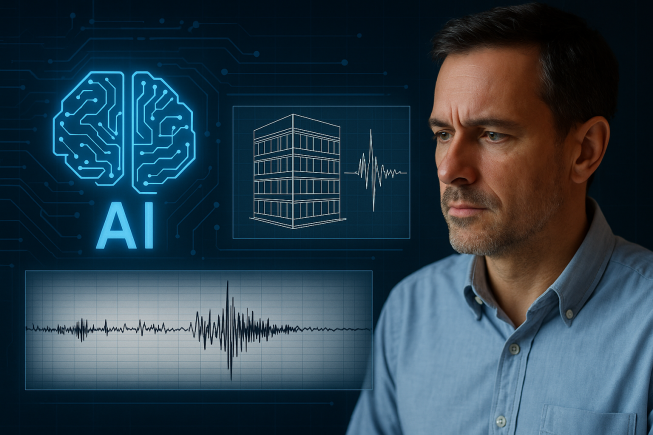
In recent years, artificial intelligence (AI) has become a powerful tool in various sectors. In earthquake engineering, too, intelligent algorithms and data analysis are revolutionising the way we study earthquakes and construct safer buildings. According to the United Nations, the UNDRR 2023 report explains how the use of AI and big data improves natural disaster prevention and response, illustrating practical examples from around the world.
Structural design
AI also plays a role in the design of buildings and infrastructure. The study published in Engineering Structures by Zheng and colleagues shows through simulations how AI can quickly test many construction solutions and find the safest one against tremors. Also worth mentioning is Xinzheng Lu’s study, entitled From “Simulation-driven” Urban Disaster Mitigation to “Generative AI-powered” Seismic Design, presented in a keynote speech at WCEE2024. In his plenary session, Lu illustrated the transition from “simulation-driven” models to seismic design based on generative artificial intelligence, capable of creating optimised structures in seconds. His approach combines engineering data and generative models to make urban design faster, more resilient and more accurate.
Structure monitoring
From a monitoring perspective, the paper A real-time structural seismic response prediction explains how sensors and AI, by analysing data in real time, can detect even small changes in the structural health of buildings, allowing for rapid intervention in the event of problems. Prof. O’Reilly’s SONATA project is also certainly important, introducing advanced sensors and artificial intelligence to assess the seismic safety of buildings in real time, allowing risks to be quickly identified and managed, including through data and images collected by citizens and drones. This innovation aims to create smart buildings and increase urban resilience, improving post-earthquake decision-making and reducing losses and downtime.
Emergency management
After an earthquake, AI helps to quickly assess damage using images taken by satellites and drones. The European programme Copernicus EMS of the ESA provides practical examples of how AI-generated maps are now used by civil protection and operators to understand where to intervene first and best. A study by Stanford University shows how artificial intelligence systems were able to quickly identify areas affected by a sequence of earthquakes, providing concrete help in both damage assessment and relief planning. This is where IDEA (Image Database for Earthquake Damage Annotation) comes in, a dataset developed by researchers at the Eucentre Foundation that collects over 5,400 real images of structural and non-structural damage, acquired during post-earthquake inspections and annotated by structural engineers. Available in open access on Zenodo, IDEA is a reference resource for training and validating deep learning algorithms dedicated to automatic damage recognition. Thanks to a system of standardised annotations and a detailed structural ontology, the database improves the reliability of automatic analysis models and supports monitoring, post-event inspection and emergency management activities.
Future opportunities and challenges
The growth of AI in earthquake engineering generates enthusiasm, but also new responsibilities. For example, the international document Responsible AI in structural engineering clearly explains why it is important for data and algorithms to remain transparent and easily verifiable, preventing automation from taking the place of expert engineers’ judgement. The OECD Principles for AI 2024 document (designed specifically for citizens) provides “ethical” rules for the responsible development and use of artificial intelligence.
A valuable ally
Artificial intelligence is not a magic wand, but a powerful tool that, if well managed, can make us safer and better prepared for earthquakes. New technologies, as also mentioned in the Special Report 2025 UNDRR, are already enabling cities and communities around the world to respond and rebuild faster, reducing risks and saving lives. However, their full potential can only be realised if they are based on solid earthquake engineering foundations: it is scientific and technical knowledge of structural behaviour that provides the essential foundation for artificial intelligence tools to be truly effective and reliable in supporting seismic risk prevention and management.