
 Eucentre is a non-profit private law foundation whose mission is to conduct research and provide training and services in earthquake and safety engineering
  Eucentre promotes science, research and innovation for the benefit of the community, offering targeted methodologies and concrete solutions for prevention, safety and resilience. It collaborates with institutions and companies to disseminate competencies for the common good.
 Eucentre conducts earthquake engineering research and risk reduction studies via laboratory testing and numerical analysis to enhance seismic performance and develop innovative solutions
  Eucentre carries out research activities in earthquake engineering and risk reduction through laboratory testing and numerical analysis, aiming to improve the seismic performance of structures and soils and to develop innovative seismic retrofitting techniques.
 The Foundation promotes diverse and high-quality training activities aimed at academic and professional contexts, with constantly updated and innovative programs and initiatives designed to meet the evolving needs of the sector and society
  Eucentre ensures communication aimed at informing institutions, professionals, and citizens about ongoing activities and projects, with the goal of disseminating useful and accessible content and knowledge. It contributes to promoting a shared and informed culture of prevention and resilience.
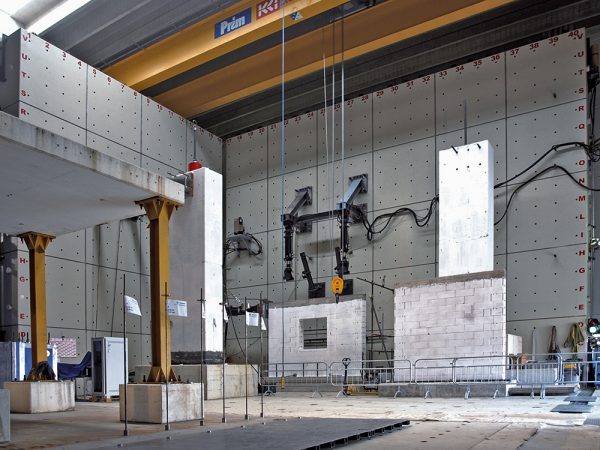
Calculations alone are not enough to design safer buildings in seismic zones. An experimental approach involving laboratory testing is also required, carried out on models that more closely resemble reality, such as full-scale models. Eucentre’s Cyclic Test System, also known as the 3D Test System, is one of the facilities that makes this type of testing possible.
What it is and how it works
The system consists of a reinforced concrete base plate and two vertical walls at right angles to each other, which together form an L-shaped structure. The test specimens, which may be full-scale buildings or individual structural and non-structural elements such as walls and infill panels, are secured to the base plate. Servo-controlled hydraulic actuators, a sort of piston anchored to the walls, apply forces and displacements with extreme precision, replicating the action that an earthquake would exert on the test specimen. The L-shaped configuration allows tests to be carried out in which forces or displacements are applied simultaneously in two directions, as occurs in a real earthquake. The design and dimensions of the Cyclic Test System also allow for great versatility in order to replicate various experimental procedures as required.
Some figures
The base plate measures 14.4 by 9.6 metres and the walls rise to a height of 12 metres, dimensions that allow for the testing of multi-storey prototypes or very large, full-scale specimens. The maximum force that can be applied exceeds 46,000 kN, equivalent to a weight of approximately 4,500 tonnes, and can be modulated thanks to eleven actuators of varying capacities and characteristics.
A world-class facility
Test systems of this type are found in only a few dozen laboratories worldwide, mainly located in Europe, the USA, China and Japan. Eucentre’s infrastructure stands out for the height of its walls, the flexibility of its actuators and the ability to operate in conjunction with the single-axis shake table at Lab01, with which it shares the same premises.
From the laboratory to safe buildings
International experimental campaigns have been conducted on the Cyclic Test System for various purposes, ranging from masonry panels to infill walls within reinforced concrete frames, reinforced concrete joints, and even buildings representative of the Dutch Groningen gas field, tested as part of studies on induced seismicity. The data collected feeds into the calibration of computational models for effective numerical modelling, supports the validation of innovative reinforcement techniques for existing buildings, and contributes both to scientific dissemination and to the updating of national and European technical regulations. What happens in the Pavia laboratory has a tangible impact on the safety of buildings and the protection of existing heritage.