
 Eucentre is a non-profit private law foundation whose mission is to conduct research and provide training and services in earthquake and safety engineering
  Eucentre promotes science, research and innovation for the benefit of the community, offering targeted methodologies and concrete solutions for prevention, safety and resilience. It collaborates with institutions and companies to disseminate competencies for the common good.
 Eucentre conducts earthquake engineering research and risk reduction studies via laboratory testing and numerical analysis to enhance seismic performance and develop innovative solutions
  Eucentre carries out research activities in earthquake engineering and risk reduction through laboratory testing and numerical analysis, aiming to improve the seismic performance of structures and soils and to develop innovative seismic retrofitting techniques.
 The Foundation promotes diverse and high-quality training activities aimed at academic and professional contexts, with constantly updated and innovative programs and initiatives designed to meet the evolving needs of the sector and society
  Eucentre ensures communication aimed at informing institutions, professionals, and citizens about ongoing activities and projects, with the goal of disseminating useful and accessible content and knowledge. It contributes to promoting a shared and informed culture of prevention and resilience.
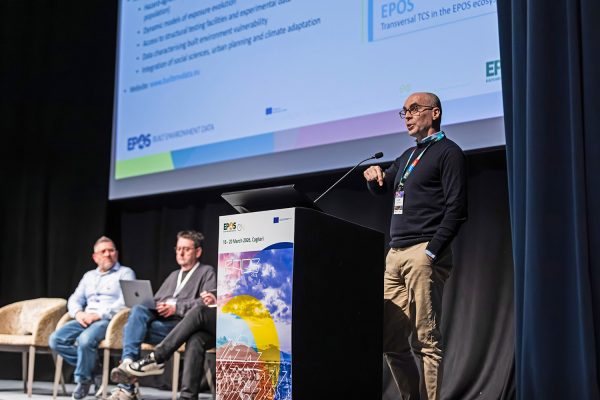
The EPOS Days 2026 event, held in Cagliari from March 16th to 20th, provided the occasion for the Eucentre Foundation to bring to the attention of the European scientific community a significant institutional achievement: the formal submission of the Built Environment Data (BED) candidate application as a new Thematic Core Service (TCS) within the EPOS ERIC (European Plate Observing System – European Research Infrastructure Consortium).
The candidacy was presented by Eucentre’s President, Prof. Rui Pinho, and was formally submitted on 13 March 2026 to the Executive Director of EPOS ERIC, Dr Lilli Freda, at the conclusion of a four-year preparation process through which the BED community organised itself in a cohesive and structured manner around a shared scientific objective.
What is Built Environment Data
BED was conceived to address the growing demand from society and the research community for structured, accessible and interoperable data on the built environment. The initiative proposes to provide, within the EPOS ecosystem, data, data products, services and software (DDSS) related to buildings and urban infrastructure, in compliance with FAIR principles (Findable, Accessible, Interoperable, Reusable) and in line with broader European efforts to advance Open Science.
The built environment lies at the core of multi-hazard risk assessments addressing not only earthquakes but also tsunamis, floods, extreme climatic events, and other natural, technological and anthropogenic hazards. BED therefore aims to complement the services already delivered by EPOS’ existing TCSs, avoiding duplication of effort whilst opening new directions for interdisciplinary research.
The proposed services include hazard-agnostic exposure databases (buildings, infrastructure and population), dynamic models of exposure evolution, access to structural testing facilities, data characterising built environment vulnerability, and access to experimental datasets.
Support from 26 Institutions
The candidacy is supported by 26 organisations from 14 countries, including universities, national laboratories and research foundations from Italy, Greece, Portugal, Switzerland, the United Kingdom, Spain, France, Belgium, Slovenia, Serbia, Croatia, the Republic of North Macedonia, the Netherlands, and Canada.
The Eucentre Foundation acts as the coordinating organisation. Prof. Pinho leads the initiative in his capacity as President of the Foundation, which also serves as the Risk Service Provider for EPOS’ Seismology TCS, thereby fulfilling a strategic bridging role across the infrastructure’s thematic services.
An Active Services Portfolio
At the time of submission, BED already counts six operational services:
Experiments, managed by Eucentre in collaboration with the University of Pavia, IUSS Pavia and GEM Foundation, provide open access to experimental test data on the performance of buildings and infrastructure, with a taxonomy-based search engine and Creative Commons CC-BY licences assigned to each dataset via Digital Object Identifiers (DOIs).
RESSLab-hub, developed by EPFL, provides open-access structural performance databases for steel structures alongside interactive component modelling and fragility functions, aimed at advancing knowledge for minimising earthquake risk.
URM Data, curated by EPFL’s Earthquake Engineering and Structural Dynamics (EESD) group, is an interactive web-based platform collecting shake table test data for unreinforced masonry (URM) buildings, including ready-to-use numerical models in OpenSees.
Stone Masonry Data, also developed by EPFL’s EESD group, is a database of shear-compression tests on stone masonry walls, providing stiffness, strength and drift capacity data to support city- and regional-scale research.
SimDesign, managed by Eucentre, implements a collaborative framework for the simulated design of buildings according to past and current European earthquake design procedures, generating OpenSees numerical models for non-linear analysis and probabilistic seismic demand modelling.
Embodied Carbon, developed by GEM Foundation, provides data and maps of the embodied carbon associated with the seismic damage repair and replacement of residential, commercial and industrial buildings worldwide.
Two further services — Building Imagery Database (GEM) and the European Multi-hazard Built Environment Exposure Database (University of Aveiro) — are currently being developed.
A Candidacy Four Years in the Making
In formally submitting the application, Prof. Pinho emphasised that the four-year preparation process had itself constituted a transformation for the BED community, which consolidated expertise in FAIR data stewardship, open data and code provision, and interoperable services development. The integration of BED into EPOS will connect built environment data with the seismological, geodetic and tsunami warning services already available within the infrastructure, paving the way for European-scale multi-hazard risk assessment and contributing to the safety, resilience and sustainability of European society.