
 Eucentre is a non-profit private law foundation whose mission is to conduct research and provide training and services in earthquake and safety engineering
  Eucentre promotes science, research and innovation for the benefit of the community, offering targeted methodologies and concrete solutions for prevention, safety and resilience. It collaborates with institutions and companies to disseminate competencies for the common good.
 Eucentre conducts earthquake engineering research and risk reduction studies via laboratory testing and numerical analysis to enhance seismic performance and develop innovative solutions
  Eucentre carries out research activities in earthquake engineering and risk reduction through laboratory testing and numerical analysis, aiming to improve the seismic performance of structures and soils and to develop innovative seismic retrofitting techniques.
 The Foundation promotes diverse and high-quality training activities aimed at academic and professional contexts, with constantly updated and innovative programs and initiatives designed to meet the evolving needs of the sector and society
  Eucentre ensures communication aimed at informing institutions, professionals, and citizens about ongoing activities and projects, with the goal of disseminating useful and accessible content and knowledge. It contributes to promoting a shared and informed culture of prevention and resilience.
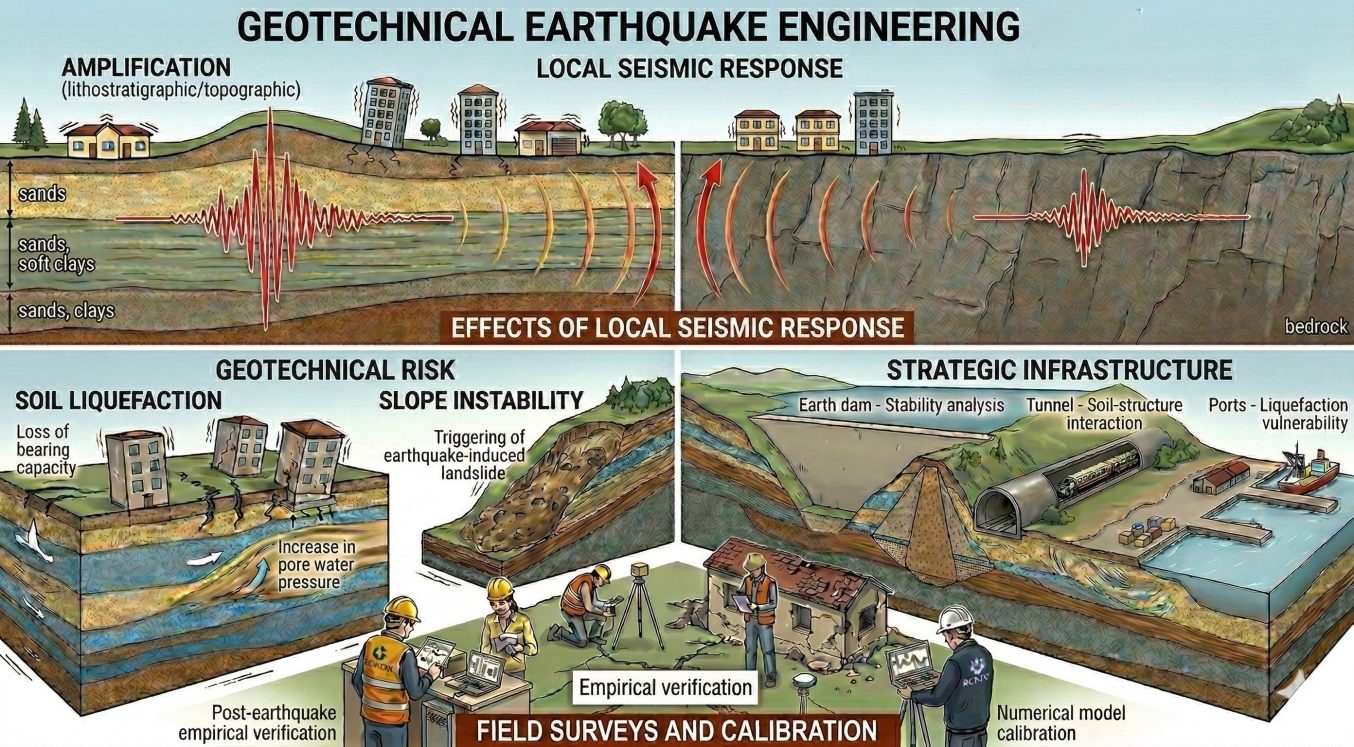
When discussing seismic risk, attention often focuses on structures: buildings, bridges, and viaducts. Yet even before seismic waves reach a structure’s foundations, they pass through surface soil deposits, which profoundly alter their characteristics. The soil is not an inert medium: it is a dynamic filter that can amplify, attenuate, or alter the frequency content of seismic motion. Understanding this interaction is the task of geotechnical earthquake engineering.
The Eucentre Foundation works in this field with an integrated approach that spans the entire knowledge chain: from estimating expected shaking to geotechnical risk assessment, from the vulnerability of strategic infrastructures to empirical verification through post-earthquake field surveys.
The local seismic response: why the same earthquake produces different effects
The first pillar of research concerns the calculation of expected seismic shaking at a specific site or across an extended area. Eucentre develops advanced models for analysing the local seismic response, a process that makes it possible to estimate how the mechanical properties of the soil – composition, density, stiffness, degree of saturation – influence seismic motion at the surface. Soils with different characteristics can produce drastically different ground accelerations for the same seismic event at the source.
The accurate definition of response spectra is a prerequisite for structural design. An overestimated spectrum leads to the overdimensioning of structures, resulting in a waste of economic resources. An underestimated spectrum exposes structures and people to risks that are not adequately covered. The objective is to find a balance between safety and the economic sustainability of construction.
Geotechnical risk: liquefaction and slope instability
Seismic action can produce effects that go far beyond the direct structural damage caused by shaking. The shaking itself can generate permanent ground deformation, differential subsidence, and loss of bearing capacity, with potentially catastrophic consequences. Eucentre’s research focuses on the multi-scale assessment of these geotechnical risks.
Soil liquefaction is among the most insidious phenomena. In saturated sandy soils, seismic vibrations increase interstitial pressures (neutral pressures), potentially negating soil strength. The soil, in effect, temporarily behaves like a fluid, leading to the collapse of overlying structures through loss of support. Slope instability is a second critical area: earthquakes can trigger landslides, activating sliding in slopes that would be stable under static conditions. Predictive modelling of these scenarios requires integrating geological, geotechnical, and dynamic data.
Strategic infrastructures and underground works
A country’s operational continuity during a seismic emergency depends on the resilience of its critical infrastructure. Eucentre develops methodological and numerical tools to define the seismic vulnerability of complex works that each present specific geotechnical problems.
Port and airport systems, for example, are often built on loose or backfilled soils, which are particularly sensitive to site effects and liquefaction. Earth dams and retaining structures pose integrity issues; their compromise would have immediate repercussions for hydraulic safety and downstream slope stability. Finally, underground works and tunnels exhibit a very peculiar soil-structure kinematic interaction, profoundly different from that of elevated works: here, it is the surrounding soil that governs the structure’s response, not vice versa.
Field surveys: the empirical feedback of models
No numerical model, however sophisticated, can do without empirical verification. The Eucentre Foundation is systematically engaged in field survey activities following seismic events, both nationally and internationally. The systematic documentation of real geotechnical damage enables the identification of collapse mechanisms previously unaccounted for in theoretical models, the calibration of calculation software through real case studies, and the development of evidence-based guidelines for the reconstruction and reinforcement of existing infrastructure.
This continuous cycle between modelling, observation, and refinement is the hallmark of an approach to research that is not exhausted in theory but is constantly measured against the reality of phenomena.
A starting point, not an ancillary discipline
Geotechnical earthquake engineering is not a niche specialisation within earthquake engineering: it’s its starting point. Every urban and territorial resilience strategy must be based on an understanding of soil behaviour, because it is through the soil that seismic action propagates before reaching structures. The integration of geotechnics, risk analysis, and post-event monitoring enables the Eucentre Foundation to translate scientific research into operational tools in the service of collective safety.