
 Eucentre is a non-profit private law foundation whose mission is to conduct research and provide training and services in earthquake and safety engineering
  Eucentre promotes science, research and innovation for the benefit of the community, offering targeted methodologies and concrete solutions for prevention, safety and resilience. It collaborates with institutions and companies to disseminate competencies for the common good.
 Eucentre conducts earthquake engineering research and risk reduction studies via laboratory testing and numerical analysis to enhance seismic performance and develop innovative solutions
  Eucentre carries out research activities in earthquake engineering and risk reduction through laboratory testing and numerical analysis, aiming to improve the seismic performance of structures and soils and to develop innovative seismic retrofitting techniques.
 The Foundation promotes diverse and high-quality training activities aimed at academic and professional contexts, with constantly updated and innovative programs and initiatives designed to meet the evolving needs of the sector and society
  Eucentre ensures communication aimed at informing institutions, professionals, and citizens about ongoing activities and projects, with the goal of disseminating useful and accessible content and knowledge. It contributes to promoting a shared and informed culture of prevention and resilience.
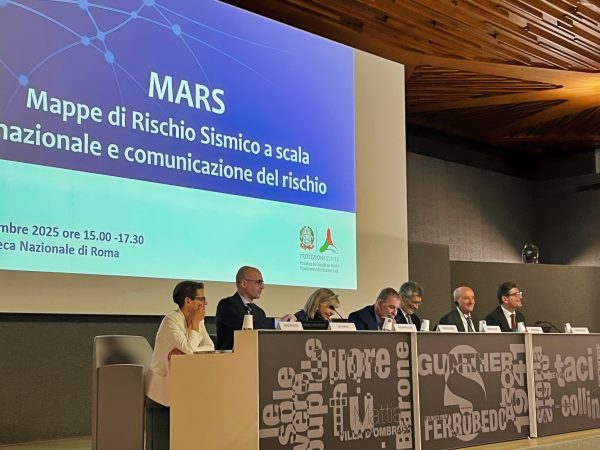
On December 1st, 2025, the technical-scientific event dedicated to MARS – Maps of Seismic Risk on a National Scale and Risk Communication, an initiative promoted by the Civil Protection Department in collaboration with the ReLUIS and Eucentre Competence Centres, was held at the National Library in Rome. The meeting marked the culmination of a multi-year process to develop innovative tools for seismic risk assessment and mitigation in Italy.
An advanced methodological framework for seismic risk assessment
During the proceedings, it was demonstrated that seismic risk assessment is the basis for defining, orienting, and implementing effective structural and non-structural prevention policies.
The analyses presented reaffirmed the importance of combining the three fundamental components of risk – hazard, vulnerability and exposure – modulated according to the needs of the different territorial scales.
Special attention was paid to risk ‘mapping’ using probabilistic approaches, applied to multiple building and infrastructure assets, including:
- residential buildings
- schools
- hospitals
- cultural heritage
- infrastructures of strategic interest
These assessments are an indispensable resource for the Civil Protection System’s prevention activities, such as the distribution of resources among regions, the definition of civil protection plans, and awareness-raising initiatives for the population.
A project strengthened by a consolidated scientific collaboration
During the event, it was recalled that, since 2018, the need to prepare the National Risk Assessment required by the European Union had accelerated and systematised the production of risk maps and scenarios by the Centres of Competence.
The collaboration between ReLUIS and Eucentre has led to results characterised by
- high scientific robustness
- methodological consistency
- broad consensus in the technical community
- versatility and applicability on a national scale
These tools are already used by ministries, territorial authorities, and administrations involved in seismic risk planning and mitigation.
Eucentre’s contribution: research, modelling and risk communication
The Eucentre Foundation made a significant contribution to the activities presented, participating in the session on seismic risk assessment and presenting the results obtained within the project.
The speeches by Prof. Rui Pinho and Dr Barbara Borzi deepened
- the pioneering role of Italian national risk models
- the tools used by the scientific community to develop risk models
- the tools developed on behalf of the DPC for risk management
Subsequently, Dr Barbara Borzi led a session dedicated to disseminating seismic risk information to citizens, emphasising the need to complement technical-scientific products with effective communication strategies, which are fundamental for increasing community awareness, preparedness, and resilience.
The programme and central themes of the meeting
The event, moderated by representatives of the Civil Protection Department and the Competence Centres, was structured according to the following programme:
- Opening of the session: Fabio Ciciliano, Head of the Civil Protection Department
- Maps and risk scenarios: use and requirements Paola Pagliara
- The seismic risk assessment process: history, models, tools, results and prospects: Mauro Dolce, Angelo Masi, Andrea Prota (ReLUIS), Rui Pinho, Barbara Borzi (Eucentre)
- The dissemination of seismic risk to citizens: Barbara Borzi
- Closing remarks: Luigi D’Angelo, Civil Protection Department
The facility provided a comprehensive illustration of the scientific, operational, and dissemination aspects of the MARS project.ARS as a strategic infrastructure for seismic prevention in Italy
The presentation of the Seismic Risk Maps highlighted both the maturity of the MARS project and its relevance to the entire Civil Protection System. The tools and results illustrated strengthen the ability of the institutions to
- Identify intervention priorities
- plan prevention policies more effectively
- support decisions based on reliable data and models
- improve communication with territories and citizens
For the Eucentre Foundation, this event represents a significant step in a structured collaboration with the Civil Protection Department and ReLUIS, confirming the Foundation’s role as a scientific reference in earthquake engineering and seismic risk assessment.
MARS is therefore an essential cognitive and operational infrastructure for assisting the country in advancing sustainable and community-resilient risk management.