
 Eucentre is a non-profit private law foundation whose mission is to conduct research and provide training and services in earthquake and safety engineering
  Eucentre promotes science, research and innovation for the benefit of the community, offering targeted methodologies and concrete solutions for prevention, safety and resilience. It collaborates with institutions and companies to disseminate competencies for the common good.
 Eucentre conducts earthquake engineering research and risk reduction studies via laboratory testing and numerical analysis to enhance seismic performance and develop innovative solutions
  Eucentre carries out research activities in earthquake engineering and risk reduction through laboratory testing and numerical analysis, aiming to improve the seismic performance of structures and soils and to develop innovative seismic retrofitting techniques.
 The Foundation promotes diverse and high-quality training activities aimed at academic and professional contexts, with constantly updated and innovative programs and initiatives designed to meet the evolving needs of the sector and society
  Eucentre ensures communication aimed at informing institutions, professionals, and citizens about ongoing activities and projects, with the goal of disseminating useful and accessible content and knowledge. It contributes to promoting a shared and informed culture of prevention and resilience.
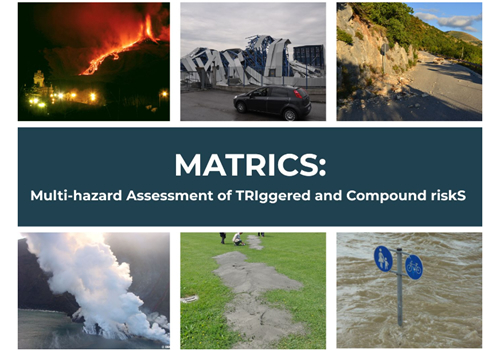
Multi-hazard damage assessment represents one of the most complex and urgent challenges in safeguarding urban settlements and critical infrastructure. In this context, the Eucentre Foundation is officially joining the MATRICS (Multi-hazard Assessment of TRIggered and Compound riskS) project, the new and ambitious research programme of the National Institute of Geophysics and Volcanology (INGV), funded under the ministerial ‘Pianeta Dinamico 2026–2029’ fund. The Foundation will contribute its expertise to the development of integrated scientific approaches and next-generation computational tools.
Eucentre’s role: from theoretical model to software platform
The scientific coordination of Eucentre’s participation is led by Barbara Borzi, the Foundation’s Director of Research. The activities will be organised around two synergistic areas of work, aimed at transforming theoretical research into operational solutions for local authorities and the scientific community:
- Development of advanced methodological frameworks: the aim is to quantify cumulative or simultaneous structural damage when earthquakes, tsunamis, landslides and soil liquefaction interact within the same area.
- Development of a dedicated software platform: an advanced computational tool that will put these methodologies into practice. The code will be released incrementally to monitor and validate the progress of the various stages of the research.
Eucentre’s established expertise in earthquake engineering and the assessment of the built environment’s vulnerability is thus extended to include the phenomena of triggering, cascading effects and the compounding of multiple natural hazards.
The MATRICS project and the scientific consortium
The MATRICS project is coordinated at the national level by Lucia Luzi, Research Director at the INGV. The scientific consortium brings together the multidisciplinary expertise of ten Italian universities, the Politecnico di Milano, Brigham Young University in the United States, and Eucentre, combining seismology, geology, structural modelling and data science. This integration of expertise is a key component of the partnership, enabling a truly multidisciplinary approach to risk assessment when multiple natural hazards affect the same territory.
Field validation: the Strait of Messina and Emilia-Romagna
The theoretical models and software tools developed within the MATRICS project will be applied and calibrated in two Italian pilot areas characterised by extremely high geological and seismic complexity:
- The Strait of Messina: an ideal natural laboratory for studying cascade effects, historically affected by the 1908 catastrophic earthquake and tsunami.
- Emilia-Romagna: an area characterised by the 2012 seismic sequence, which is crucial for analysing cumulative damage and soil liquefaction phenomena.
The choice of these areas ensures rigorous validation of the methodologies. The results of the research, which will be carried out over a four-year period, will lay the foundations for a new approach to disaster prevention and emergency management, both in Italy and in similar international contexts.