
 Eucentre is a non-profit private law foundation whose mission is to conduct research and provide training and services in earthquake and safety engineering
  Eucentre promotes science, research and innovation for the benefit of the community, offering targeted methodologies and concrete solutions for prevention, safety and resilience. It collaborates with institutions and companies to disseminate competencies for the common good.
 Eucentre conducts earthquake engineering research and risk reduction studies via laboratory testing and numerical analysis to enhance seismic performance and develop innovative solutions
  Eucentre carries out research activities in earthquake engineering and risk reduction through laboratory testing and numerical analysis, aiming to improve the seismic performance of structures and soils and to develop innovative seismic retrofitting techniques.
 The Foundation promotes diverse and high-quality training activities aimed at academic and professional contexts, with constantly updated and innovative programs and initiatives designed to meet the evolving needs of the sector and society
  Eucentre ensures communication aimed at informing institutions, professionals, and citizens about ongoing activities and projects, with the goal of disseminating useful and accessible content and knowledge. It contributes to promoting a shared and informed culture of prevention and resilience.
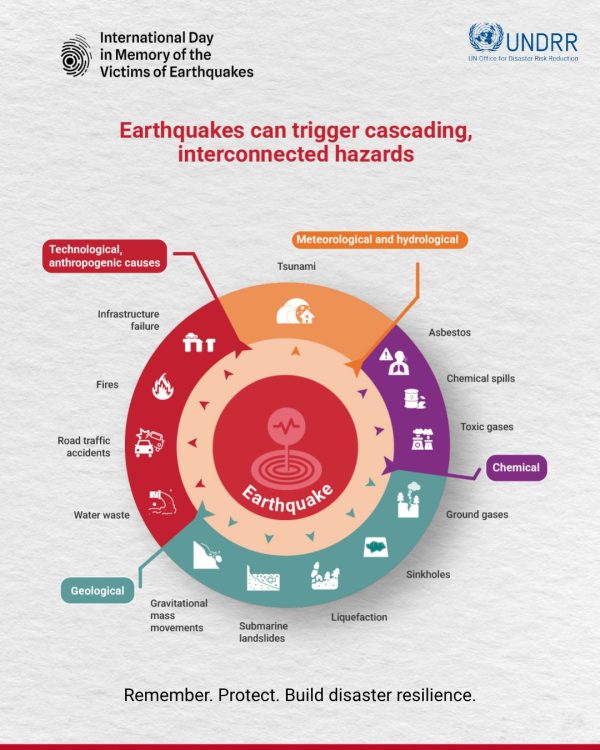
On 29 April 2026, the world observes the International Day in Memory of the Victims of Earthquakes. The date was established on 29 April 2025, when the United Nations General Assembly adopted a resolution, sponsored by Uzbekistan, Chile and the Philippines, co-signed by more than eighty countries, adding this observance to the UN calendar. UNDRR, the United Nations Office for Disaster Risk Reduction, coordinates its implementation. The slogan is direct: Remember. Protect. Build Disaster Resilience.
For Italy, 29 April arrives with a measurable, specific weight. The numbers make the case without elaboration.
Italy’s seismic record: a history written in the memory
Few countries have a documented relationship with earthquakes as long and consequential as Italy’s. The peninsula lies at the convergence zone of the African and Eurasian tectonic plates, a geological position that produces high seismicity distributed along the Apennine ridge, across the Calabrian and Sicilian regions, and in parts of the north-east. Of 1,300 destructive earthquakes recorded across the Mediterranean over two millennia, more than 500 have struck the Italian territory.
The toll of the twentieth century alone exceeds 130,000 lives. Several dates have entered national collective memory in ways that have not faded.
On 28 December 1908, at 5:20 in the morning, a magnitude 7.1 earthquake destroyed Messina and Reggio Calabria in 37 seconds. Half of Messina’s population lost their lives; total casualties across both cities are estimated at approximately 120,000. It remains one of the most lethal earthquakes in European recorded history, and the international response it prompted was among the first documented examples of large-scale humanitarian cooperation.
On 13 January 1915, the Marsica, the area around Avezzano, in Abruzzo, was destroyed by a magnitude 7.0 earthquake. More than 30,000 people died across a predominantly rural territory, in buildings constructed on amplifying soils with no seismic design. The ratio between the intensity of the shaking and the death toll reflected, already then, a problem that would accompany Italy for a century: the vulnerability of its existing building stock.
On 6 May 1976, at 9:00 pm, a magnitude 6.5 earthquake struck Friuli. Approximately 990 people lost their lives, 80,000 were displaced, and 111 municipalities sustained damage of varying degrees. Major aftershocks followed on 11 and 15 September 1976, compounding the emergency considerably. The subsequent reconstruction of Friuli became an international reference for decades: a devastated territory that chose to rebuild using seismic standards then far from common practice, anticipating norms that would become regulatory requirements only years later. On 6 May 2026, seven days from this first International Day, the fiftieth anniversary of that earthquake falls. The proximity of the two dates this year is not symbolic, it is factual and worth noting.
On 23 November 1980, at 7:34 pm, a magnitude 6.9 earthquake struck a wide area of Campania and Basilicata in the Irpinia region. The shaking lasted over a minute. The death toll was 2,914; more than 9,000 were injured and some 400,000 displaced. The delay in rescue operations – several communities remained isolated for days – triggered public outrage and gave decisive impetus to the creation of Italy’s modern civil protection system. Irpinia is still cited in emergency management training as a case study in the consequences of institutional unpreparedness.
On 6 April 2009, at 3:32 am, L’Aquila was struck by a magnitude 6.3 earthquake. Three hundred and nine people died. The student residence hall and several public buildings collapsed. More than 80,000 people were displaced. The L’Aquila earthquake sparked a scientific and political debate that remains unresolved. Fifteen years on, parts of the city remain active construction sites.
On 24 August 2016, at 3:36 am, a magnitude 6.0 earthquake heavily hit Amatrice, Accumoli and Arquata del Tronto, amongst others. It was the beginning of a seismic sequence catalogued by INGV as the “Amatrice-Visso-Norcia sequence”: more than 118,000 seismic events recorded over five months, peaking on 30 October 2016 when a magnitude 6.5 earthquake – the strongest in Italy since 1980 – struck the area around Norcia. The total death toll of the sequence was 299.
These events are not a series of accumulated misfortunes. They are the product of two combined factors: high seismic hazard and the vulnerability of a building stock largely constructed before the introduction of adequate seismic standards. The distinction matters because it defines where intervention is possible.
Earthquakes do not kill people; poorly built structures do
The sentence belongs to Kamal Kishore, UN Secretary-General’s Special Representative for Disaster Risk Reduction and Head of UNDRR. It is direct, intentionally provocative, and scientifically accurate. Seismic hazard, the probability that an earthquake of a given intensity will occur in a given area within a given time period, is a natural parameter over which human intervention has no influence. Seismic risk, however, is not only hazard: it is the combination of hazard, exposure, and vulnerability. The last two factors are where science and engineering can make a demonstrable difference.
Structures can be designed to resist earthquakes, or to dissipate their energy without collapsing. Existing buildings can be retrofitted. Practitioners can be trained. Standards can be updated. Early warning systems can be built and maintained. None of this is scientifically impossible. Italy’s problem is not a shortage of knowledge. It is the gap between what research has produced and what the built environment actually expresses.
The United Nations General Assembly founded the 29 April observance partly on this recognition: that seismic risk reduction is not an academic issue, but rather a political and technical choice with direct consequences for how many people survive the next large earthquake. The Sendai Framework for Disaster Risk Reduction 2015-2030, which provides the conceptual framework for the day, identifies four priorities: understanding risk, strengthening disaster risk governance, investing in disaster risk reduction, and improving preparedness for effective response and recovery along “build back better” principles. These are not abstract aspirations. They are a measurable work programme.
The role of the Eucentre Foundation
The Eucentre Foundation was established in Pavia in 2003 as a private non-profit foundation. Its founding members are the Department of Civil Protection, the Italian Institute for Geophysics and Volcanology, the University of Pavia and the University School IUSS Pavia. The mission is operational: producing applied research in earthquake engineering and training professionals capable of translating that research into design practice and regulatory frameworks.
The Foundation’s laboratories are among the most advanced research infrastructures in Europe. Lab01 houses a 140-tonne uniaxial shake table capable of subjecting full-scale structures to seismic excitation, reproducing real or synthetic accelerograms. Lab02 is equipped with a second 30-tonne six-degree-of-freedom shake-table, which, since 2022, can operate in a nine-degree-of-freedom configuration unique in the world, an experimental capability that opens test possibilities not previously accessible. The Mobile Lab and the advanced survey and monitoring units extend the Foundation’s capacity for direct field investigation.
The outcomes of these activities feed into European and international regulatory debates, technical guidelines for public bodies, and safety assessments of critical infrastructure.
ROSE School, the advanced training programme active since 2001 and recognised as an Erasmus Mundus programme since 2006, offers master’s degrees, doctoral studies and specialist courses in earthquake engineering. Over more than twenty years, the school has trained hundreds of engineers and researchers from across the world, many of whom now work in regulatory, design and academic contexts in their countries of origin. It is one of the rare Italian cases where post-graduate training in a technical and scientific specialisation has achieved a genuinely international profile.
The 29 April observance is an occasion to measure this mission against the seismic history of the country where Eucentre operates. The earthquakes that have marked Italy over the past century are not abstractions: some of the affected areas are still under reconstruction, seismic criteria that could have reduced death tolls existed in part at the time those events occurred, and the debate on seismic retrofitting of the existing building stock remains open and unresolved.
Eucentre’s contribution to this history is measured in structural tests conducted, engineers trained, assessment protocols developed, contributions to standards and in activities of seismic risk awareness. It is not work that fits into a single observance. But a day like this constitutes a useful measure of how much remains to be done.